General Walton H. Walker: A Talent For Training by Major Adam W. Hilburgh
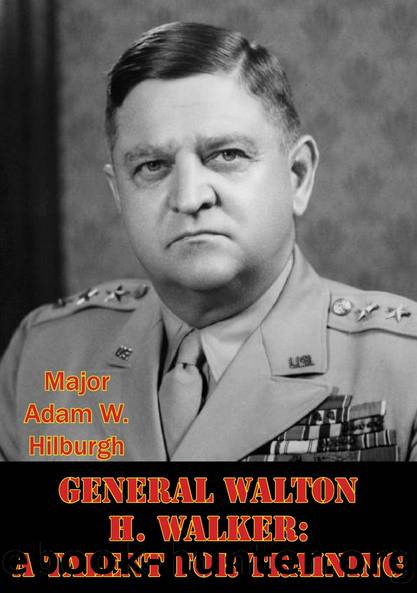
Author:Major Adam W. Hilburgh [Hilburgh, Major Adam W.]
Language: eng
Format: epub
Tags: History, Military, United States, Europe, General, Germany, Special Forces
ISBN: 9781786252906
Google: GjBwCwAAQBAJ
Publisher: Pickle Partners Publishing
Published: 2015-11-06T02:59:21+00:00
Combat and Withdrawal
Task Force Smith formed the vanguard of Eighth Army and the United States ground combat forces when North Korea invaded South Korea in June 1950. Lieutenant Colonel Charles B. Smithâs force dug in along an Osan ridgeline âto stop the North Koreans as far north of Pusan as possibleâ on July 5, 1950, just two weeks after North Koreaâs surprise attack.{186} In contrast, the 1st Infantry Divisionâs attack on Cantigny occurred on May 28, 1918, more than a year after the United States declaration of war on Germany and almost four years after the assassination of the Archduke Ferdinand.{187} Similarly, the rout of Fredendallâs II Corps at Kasserine Pass began on January 30, 1943, also more than a year after the United States declared war on the Axis, and four years after the war began in Europe on September 1, 1939.{188} The Armyâs traditional lack of military preparedness over its prior 175 years provides the context to view Eighth Armyâs rapid deployment and ultimate success in its first three months of battle.
Major General William Dean found his 24th Infantry Division committed to battle in Korea piecemeal, a regiment at a time during its first week in combat. The division and later Eighth Army as a whole faced a North Korea Peopleâs Army consisting of ten infantry divisions, mostly âhardened veterans who had fought with the Chinese Communist and Soviet Armies in World War II.â{189} Supplied, equipped, and trained by the Soviets, the NKPA possessed approximately 150 T-34 tanks and an abundance of howitzers, self-propelled guns, mortars, small arms, ammunition, and grenades. Due to the strength of the North Korean invasion, MacArthur incorrectly radioed to the Joint Chiefs that the opposing force consisted of âa combination of Soviet leadership and technical guidance with Chinese Communist ground elements. It can no longer be considered an indigenous North Korean effort.â{190} In contrast, not only did the Eighth Army suffer from significant material and personnel shortages; the allied ROK Army could provide little support. Sun Yup Paik, the ROK 1st Infantry Division commander, stated during the retreat, âWeakened by the loss of manpower and equipment from main-force units, ROK Army reached the limits of its ability to resist.â{191}
In an attempt to fill the shortages of the 24th Infantry Division, Walker transferred more than 4,500 officers, NCOs, and soldiers from the 7th and 25th Infantry Divisions and the 1st Cavalry Division.{192} The addition of these men helped the 24th Infantry Division delay the North Korean onslaught, but the limited time available to integrate these new forces degraded its combat effectiveness. Additionally, the transfer of the men hindered the deployment of the divisions sent to reinforce allied formations in South Korea by dismantling trained teams and units â an eerily similar flaw as that seen in the U.S. Armyâs World War II replacement system.{193} The lack of a third maneuver battalion per regiment and the shortages in artillery and armor in divisions deploying from Japan further degraded their fighting capacity upon arrival in South Korea.
Download
This site does not store any files on its server. We only index and link to content provided by other sites. Please contact the content providers to delete copyright contents if any and email us, we'll remove relevant links or contents immediately.
The Vikings: Conquering England, France, and Ireland by Wernick Robert(84381)
Ali Pasha, Lion of Ioannina by Eugenia Russell & Eugenia Russell(40318)
The Conquerors (The Winning of America Series Book 3) by Eckert Allan W(37983)
The Vikings: Discoverers of a New World by Wernick Robert(37006)
Cecilia; Or, Memoirs of an Heiress — Volume 1 by Fanny Burney(32636)
Cecilia; Or, Memoirs of an Heiress — Volume 2 by Fanny Burney(32010)
Cecilia; Or, Memoirs of an Heiress — Volume 3 by Fanny Burney(31996)
Empire of the Sikhs by Patwant Singh(23135)
The Secret History by Donna Tartt(19297)
Hans Sturm: A Soldier's Odyssey on the Eastern Front by Gordon Williamson(18649)
Cat's cradle by Kurt Vonnegut(15441)
Pimp by Iceberg Slim(14666)
Sapiens: A Brief History of Humankind by Yuval Noah Harari(14461)
Norse Mythology by Gaiman Neil(13458)
Talking to Strangers by Malcolm Gladwell(13440)
Leonardo da Vinci by Walter Isaacson(13411)
4 3 2 1: A Novel by Paul Auster(12513)
Underground: A Human History of the Worlds Beneath Our Feet by Will Hunt(12145)
The Radium Girls by Kate Moore(12093)
